Home > CERBE Laboratory > The sections > Highlights
highlights
A journey of innovation and commitment
Explore CERBE Laboratory’s timeline and discover how its dedication to research and innovation has evolved and shaped the laboratory’s path over the years.
Incorporation of CERBE Laboratory
CERBE Laboratory, located in Sherbrooke, Quebec (Canada), is becoming an incorporated entity. This initiative reflects a clear intent to structure its fundamental biological research activities, to strengthen its position as an independent researcher in the field of live blood, and to expand its capacity for scientific and technological innovation.
Fundamental Research
Continuation of fundamental research on live blood. This period also marks the gradual emergence of 714X, a non-toxic immunomodulatory agent designed to support and modulate the immune system.
Clinical Research
A period of clinical research carried out with patients using 714X under the direction of Gaston Naessens, highlighted by key observations on live blood that contributed to the scientific validation of somatidian orthobiology.
Pivotal Year
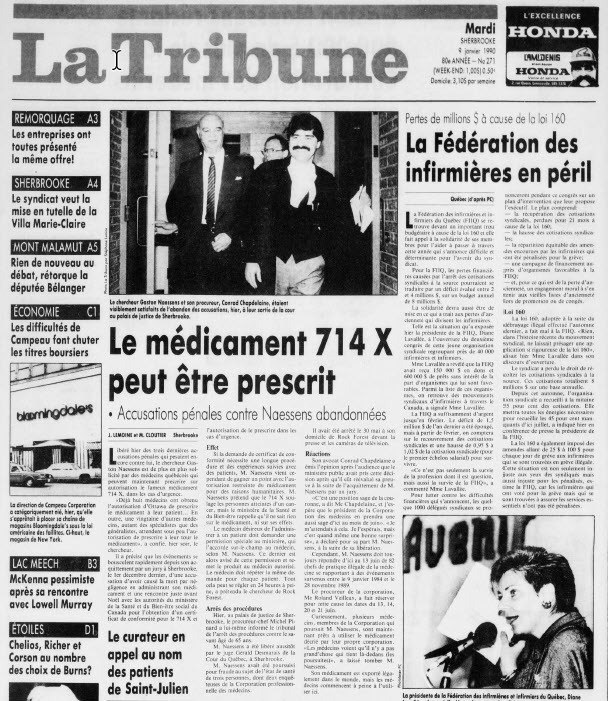
- Acquittal of Gaston Naessens by a jury, marking a major victory against the accusations brought by the College of Physicians of Quebec.
 |
 |
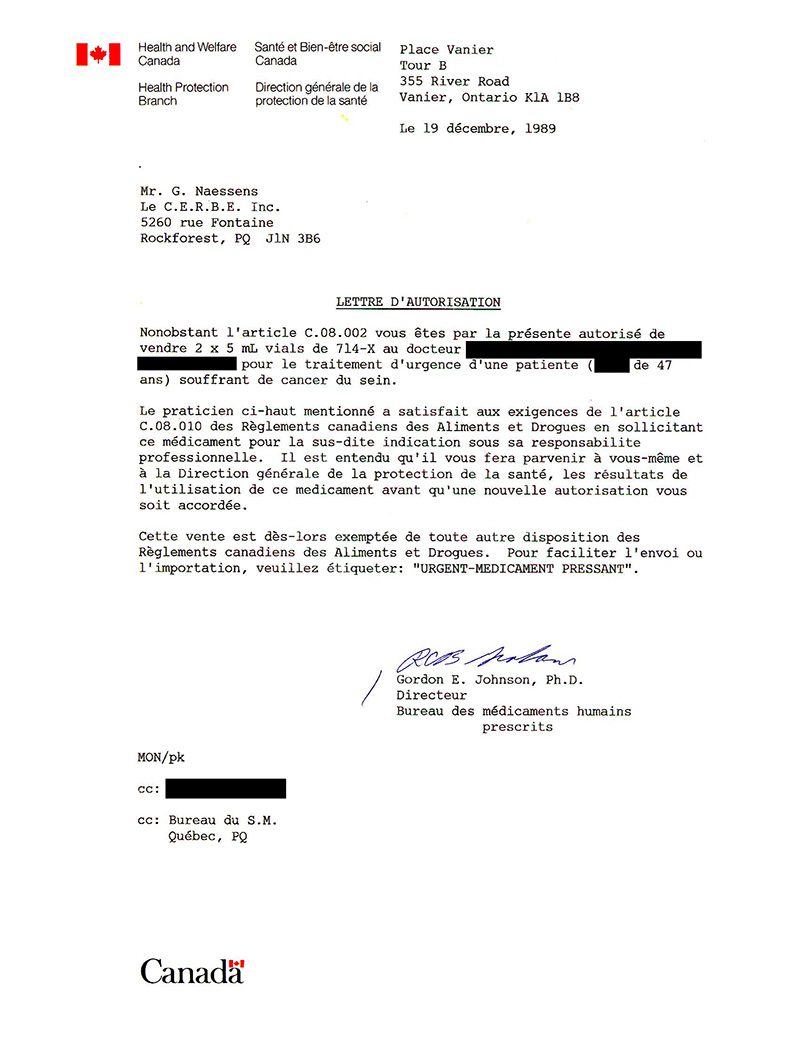
- Following this historic verdict, 714X was shortly thereafter integrated into Health Canada’s Emergency Drug Release Program.
 |
Attestation of Sterility and Composition of 714X
The Canadian Department of Health and Welfare validates the sterility tests and confirms the composition of 714X.
Maintaining 714X within the Canadian Special Access Program (SAP)
Health Canada’s Emergency Drug Program has evolved into the Special Access Program (SAP). 714X remains part of this exceptional framework, which was originally established on compassionate grounds. This ensures its availability, under medical supervision, in specific and regulated situations, particularly for degenerative or debilitating diseases such as cancer, autoimmune disorders, and neurodegenerative diseases.
First Peer-Reviewed Publication
Dr. Elizabeth Kaegi authored the first article on 714X in the Canadian Medical Journal, a recognized peer-reviewed scientific journal.
Scientific Validation
The Dana-Farber Cancer Institute (United States) validated for the first time the biochemical action of 714X on the immune system through an in vitro immunological assay. This study was conducted under the direction of researchers Arthur Pardee, PhD, and Dr. Lili Huang, PhD.
Invitation to participate in the NCI-OCCAM Best Case Series
Dr. Jeffrey White from NCI-OCCAM (United States) invited Mr. Gaston Naessens to participate in the Best Case Series program, which brings together the most promising clinical cases reported by 714X users.
Research Partnership
A tripartite collaboration involving the University of Montreal, the Lucie and André Chagnon Foundation (represented by Mr. André Chagnon), and CERBE Laboratory (represented by Mr. Gaston Naessens), as part of a research project on somatidian orthobiology, under the scientific direction of Moïse Bendayan, PhD, professor emeritus and distinguished researcher.
European Patent
Patent granted for 714X in 15 European jurisdictions, under its official chemical designation—trimethylbicyclonitraminoheptane chloride—categorized as an immunomodulatory agent.
Federal Court Ruling
The Federal Court of Canada officially granted continued access to 714X for all patients, both new and existing, under Health Canada’s Special Access Program (SAP).
Japanese Partnership
Beginning of a partnership with a Japanese medical delegation that adopted the use of 714X in their private institutions—a collaboration that remains active to this day.
Canadian Patent
Canadian patent granted for 714X, under its official chemical designation—trimethylbicyclonitraminoheptane chloride—categorized as an immunomodulatory agent.
Japanese Patent
Japanese patent granted for 714X, under its official chemical designation—trimethylbicyclonitraminoheptane chloride—categorized as an immunomodulatory agent.
Passing of Gaston Naessens
Gaston Naessens, father of the theory of somatid orthobiology and inventor of the somatoscope, discovered the somatid in live blood. He passed away peacefully at his home at the age of 93.
He was the founder of CERBE Laboratory and the developer of the product 714X.
Passing on the Scientific and Human Legacy
His wife, Jacinte Levesque Naessens, has taken over the leadership of the CERBE Group as Chief Executive Officer, ensuring the continuity of Gaston Naessens’ scientific and human legacy.
Reorganization of CERBE Group
Strategic reorganization of the CERBE Group: consolidation of the laboratory’s activities and redesign of the website to promote somatidian orthobiology and raise international awareness of the benefits of 714X.